

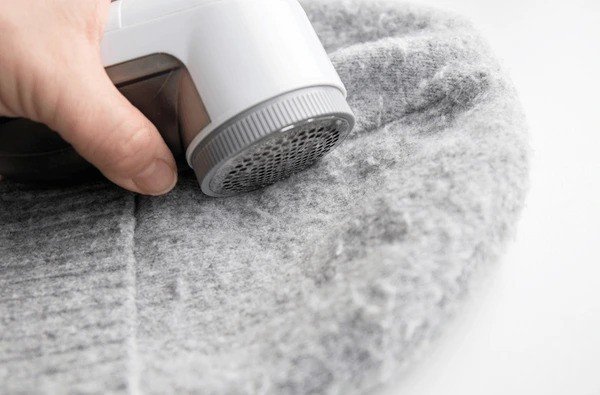
Those small fuzzy balls that show up on a sweater’s surface after a few wears aren’t a sign the garment is wearing out. They’re loose fibres that have worked free from the weave and tangled together, and in most cases they can be removed without any lasting damage. The part that actually ruins sweaters is using the wrong tool for the fabric.
Key Takeaways
- Pilling happens from friction, not poor quality. Even expensive cashmere pills.
- Match the tool to the fabric. Fabric shavers and razors cut pills off and can nick delicate knits; combs and stones pull pills off and are gentler but slower.
- Delicate fibres (cashmere, merino, fine wool) do best with a sweater comb. Heavier fabrics (wool coats, cotton knits) tolerate an electric shaver.
- Always test on an inside seam first, especially on anything you haven’t de-pilled before.
- Washing less often and inside out reduces future pilling more than any tool does.
Why Sweaters Pill in the First Place
Pilling comes from friction. Every time fabric rubs against itself, against a bag strap, against a car seat, short fibres work loose from the weave. Loose fibres tangle together into small balls, and because they’re still anchored to the fabric by a few threads, they don’t fall off on their own.
Looser, softer weaves pill faster because their fibres have more room to work free. This is why a loosely knit cashmere jumper often pills sooner than a tightly woven cotton one, even though cashmere is the more expensive fibre. Pilling is not a reliable sign of low quality; it is a sign of where a fabric rubs.
Match the Tool to the Fabric First
Every de-pilling tool works one of two ways: it cuts the pill off, or it pulls the pill off. That distinction matters more than price or speed.
| Tool | How it works | Best for | Risk |
|---|---|---|---|
| Sweater comb | Pulls pills free without cutting fibres | Cashmere, merino, fine or delicate knits | Low risk, but slower and needs firm pressure |
| Electric fabric shaver | Cuts pills off with a rotating blade | Heavier wool coats, cotton knits, fleece | Can nick or thin delicate fabric if pressed too hard |
| Pumice-style sweater stone | Abrades pills off the surface | Mid-weight knits | Can flatten texture on very soft or fine fabric |
| Disposable razor | Shaves pills off in a single pass | Flat, tightly woven fabric | Highest risk of cutting the fabric itself, not just the pill |
| Lint roller | Lifts very light, loose pilling only | Light maintenance between proper de-pilling | Minimal risk, but ineffective on established pills |
The comb-versus-shaver choice is the one that matters most. A comb pulls the whole pill free at the root, so once it’s gone, that spot is genuinely clear. A shaver or razor cuts the pill off at the surface, which is faster, but the fibre ends left behind can fray and re-form into a new pill sooner. On a $30 acrylic jumper that trade-off barely matters. On fine cashmere, it’s the difference between a garment that looks good for years and one with a thin patch after a single overzealous session.
How to De-Pill Safely, Step by Step
- Lay the sweater flat on a hard surface. Working on a soft surface like a bed makes it harder to apply even pressure.
- Test on an inside seam or hem first, especially with a tool you haven’t used on this garment before.
- Work in one direction only, following the direction of the knit rather than moving back and forth.
- Use light, even pressure. More pressure does not remove pills faster; it increases the risk of thinning the fabric.
- Shake or brush the garment afterward to clear loose fibres before wearing or storing it.
In our own household this rarely becomes a real problem, and the reason isn’t luck. Before wearing or washing anything new, we check the washing instructions on the label first, which is a step most people skip entirely. Following the care label consistently, rather than guessing at wash temperature or ignoring it, is a large part of why pilling stays minor and infrequent here rather than turning into something that needs serious de-pilling.
The one time it needed real attention was a Bonanza sweater, roughly two to three years old by the time it happened. The pilling showed up specifically at the elbows and across the back shoulder, which lines up with where a sweater actually takes the most friction: elbows from arm movement, and the shoulder area from bag straps and leaning against chair backs. A fine-tooth comb cleared it eventually, but it wasn’t quick. Both spots took real effort, and the whole process ran to 40 or 50 minutes rather than the few minutes a lighter case might take. That’s worth knowing going in: a comb is gentler on the fabric than a shaver, but gentle doesn’t always mean fast, especially once pilling has built up over a couple of years rather than being caught early.
What Actually Prevents Pilling
No fabric is entirely pill-proof, but frequency and friction both make a measurable difference. The same logic applies to other garments too: it’s the same reasoning behind why washing black jeans less often keeps them from fading, since every wash cycle is a round of friction and chemical exposure, not just for denim.
- Wash less often. Every wash cycle is a round of friction against the machine drum and other garments. Spot-clean small marks instead of running a full wash for light wear.
- Turn it inside out. This puts the friction on the inner face rather than the side that shows.
- Wash with similar-weight items. A delicate jumper washed alongside jeans or anything with zips will pill faster from the abrasion against heavier fabric.
- Use a mesh laundry bag for hand-wash-only or delicate knits if machine washing on a gentle cycle.
- Avoid over-drying. Heat makes fibres more brittle and prone to breaking loose, which is part of what feeds pilling in the first place.
Which Fibres Pill Most
| Fibre | Pilling tendency | Why |
|---|---|---|
| Cashmere | High | Short, fine fibres with a loose twist come free easily |
| Merino wool | Moderate to high | Fine fibre, though tighter-spun merino pills less than loosely spun |
| Acrylic | High | Synthetic fibres are strong, so pills form easily and don’t break off on their own |
| Cotton knit | Low to moderate | Coarser, longer fibres are more securely anchored |
| Tightly woven wool | Low | Less loose fibre available to work free in a dense weave |
Acrylic pilling more than cashmere in some cases surprises people, since acrylic is usually the cheaper fibre. The reason is durability working against it here: acrylic fibres are strong enough that once a pill forms, it doesn’t wear away or break off the way a weaker natural fibre pill eventually would. It just sits there and grows.
Who This Suits, and When to Get Help Instead
Hand-combing or careful shaver use at home works for the vast majority of pilling on sweaters, coats, and knitwear. It’s a poor fit for anything genuinely valuable and unfamiliar; a vintage or heirloom knit, or a fibre blend you’re unsure about, is worth a first attempt by a dry cleaner experienced with delicate garments rather than risking it yourself.
Skip de-pilling altogether on anything already thinning or with visible holes forming. At that point the fabric is too weak to tolerate any tool safely, and further mechanical action usually makes it worse rather than better.
Frequently Asked Questions
Does pilling mean a sweater is low quality?
Not necessarily. Pilling comes from friction and how loosely a fibre is spun, not from price. Some expensive cashmere pills faster than cheaper, tightly woven fabric, because looser spinning lets fibres work free more easily.
Is it safe to use an electric fabric shaver on cashmere?
With caution. A sweater comb is generally safer for cashmere and other delicate knits, since it pulls pills free rather than cutting them, reducing the risk of thinning the fabric. If using a shaver, use the lowest setting and very light pressure.
Will pilling come back after I remove it?
Yes, to some degree, since the fabric will continue experiencing friction with normal wear. Washing less often, turning garments inside out, and using a mesh bag for delicate items all slow how quickly it returns.
Why does my acrylic sweater pill more than my wool one?
Acrylic fibres are strong enough that pills don’t naturally break away once formed, so they accumulate rather than wearing off. Wool and other natural fibres are more likely to shed pills on their own over time.
What’s the fastest way to de-pill a large sweater?
An electric fabric shaver is fastest for heavier or sturdier knits. For anything delicate, a sweater comb is slower but safer, and speed shouldn’t be the priority on fabric that’s easy to damage.
What to Do First
Identify the fabric before picking up any tool. Delicate fibres get a comb; sturdier knits can handle a shaver. Test on a seam first regardless of which tool you use, and wash less often afterward to slow the pilling from coming straight back.

