

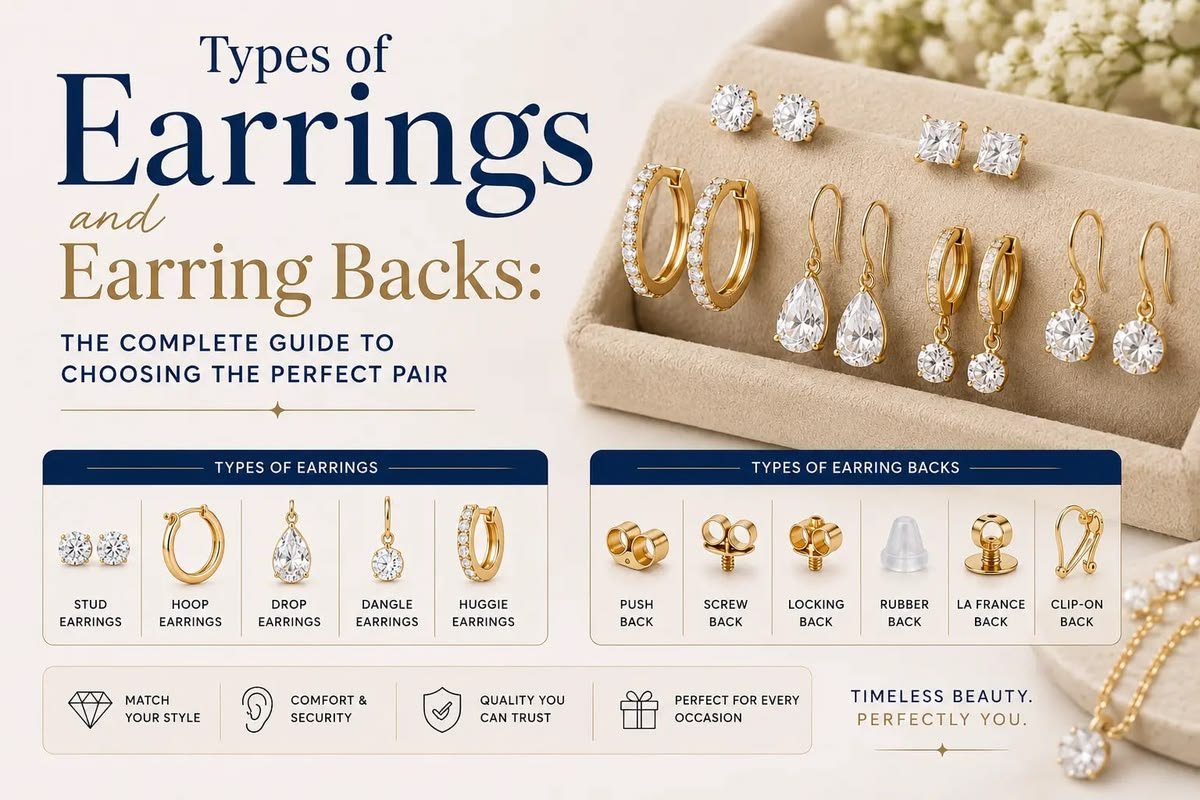
By Mania, Senior Style Editor at WFashionLady
About three to four years ago I lost a solitaire diamond stud. The back on it was the stock push back that came with the earring, a standard 5 mm butterfly back, and it slipped off. I never saw the stud fall. I searched the room, the carpet, my sweater and my clothes thoroughly and found nothing, so by elimination I assume it came off while I was out walking or running errands. I replaced the butterfly backs on all my valuable diamond and precious stone studs with locking clutches straight away. Below are the backs I have used, the one I trust with valuable pieces, and what holds my heavy drops.
Key Takeaways
- A push back (butterfly) pulls off in under 1 second, and that same loose slide is why I no longer trust it with valuable studs.
- The spring-loaded locking bullet clutch is my favorite back. I have used mine continuously for about 3 to 4 years without losing an earring.
- Silicone backs sagged under my heavy earrings, so I now keep them only as emergency spares.
- For heavy statement drops, my large disc back (11 mm) stayed upright for a full day, while a 5 mm butterfly back let the same kind of drop tilt within 10 to 15 minutes.
How the Backs I Have Used Compare
| Back | Security | On and Off | Sleeping | Gym | Heavy Earrings | Wear-Out |
|---|---|---|---|---|---|---|
| Push back (butterfly) | Loosens over time, so I no longer use it for daily wear | Pulls off in under 1 second with one quick slide | Long, pointed posts sticking out past the back dug into the bone behind my ear when I slept on my side | Cheap alloy ones trapped sweat and irritated my skin | Small ones let heavy drops tilt forward | Slides on with no resistance or feels floppy; loosens after about 6 to 12 months of regular wear (my estimate) |
| Locking back (spring clutch) | Never lost an earring with one | About 2 to 3 seconds: pinch both rear release tabs at once | I fell asleep in them once by mistake; the rigid metal of the release tabs pressed into the bone behind my ear and woke me. I take them off every evening | The one that stayed put during workouts | Worn with medium-to-heavy statement drops | Used continuously for about 3 to 4 years; never failed mechanically; plating can wear off |
| Silicone back | Gripped smooth posts well | Slides on smoothly | Zero poking into my neck | Okay for light studs in a quick sweat session | Rubber flexed and the earring sagged forward | Went stiff, yellowish and brittle after about 3 to 4 months of continuous use |
| Lever back | Never lost an earring with one; the lever clicks shut | Hinged lever closes behind the lobe | Never slept in one; the bulky hinge feels awkward | Only with lightweight drops | Worn with dangling drop earrings | Hinge rarely breaks; snap tension loosens slightly after a few years |
Push Backs: Easy, but Not Secure Enough
A push back pulls off in under 1 second with a single quick slide. The metal tension loosens over months of sliding on and off, and one of these is what I lost my diamond stud to. Now I wear them only for short periods with lightweight costume studs, where convenience matters more than security.
Cheap alloy butterfly backs also gave me redness and itching on the back surface of my earlobe, where the back pressed and rubbed against the skin, and along the piercing track.
Locking Backs: My Favorite
My locking backs are spring-loaded bullet clutches. The internal spring grips the notched post tightly, and I have to pinch the dual rear release tabs at the same time to slide the back off. That takes about 2 to 3 seconds, against under 1 second for a push back. I wear them with high-value diamond and gemstone studs, at the gym, and with medium-to-heavy statement drops. I have used them continuously for about 3 to 4 years and none has failed mechanically, though a plated finish can wear off after many years of use.
I do not sleep in them. I fell asleep in locking backs once by mistake, early on after switching to them. When I turned onto my side, the rigid metal of the release tabs pressed into the bone behind my ear and woke me. I take them off every evening now.
Silicone Backs: Spares Only
Silicone backs slide on smoothly and grip smooth posts well, and I wore them with delicate fashion studs. In my own use they absorbed hair oils, sunscreen and skin creams, and after about 3 to 4 months of continuous wear they went from clear and flexible to stiff, yellowish and brittle. I often had to throw cracked ones away. With heavy earrings the soft rubber flexed and the earring sagged forward. They are fine for light studs during a quick sweat session, and I never lost an earring with one. Now I keep them only as emergency spares in my travel kit.
Lever Backs
A lever back is a hinged closure where the curved wire clicks shut behind the earlobe. I wear mine with dangling drop earrings, and the click tells me by sound and feel that it is closed. The hinge rarely breaks, but after a few years the snap tension can loosen slightly and it needs a gentle manual adjustment to click securely. I have never slept in one because the bulky hinge feels awkward against my head.
Heavy Earrings: What I Measured
My two heavy test pairs were crystal chandelier earrings and large geometric brass-and-crystal drops. The posts are standard, roughly 0.8 mm to 1.0 mm thick.
With a standard 5 mm butterfly back, my drops started tilting forward within 10 to 15 minutes. The heavy drop pulls forward on the piercing hole, and I feel that strain as a pulling sensation. I call it the droopy earlobe effect.
| Back | Width | Result on my heavy drops | Time |
|---|---|---|---|
| Standard butterfly | 5 mm | Tilted forward | 10 to 15 minutes |
| Silicone | About 6 to 7 mm | Rubber flexed and the earring sagged forward | About 30 to 45 minutes |
| Large disc back | 11 mm | Stayed flush and upright | A full-day event, roughly 8 to 10 hours |
I measured the disc back with a ruler: it is slightly more than double the width of the butterfly back.
When a Back Does Not Fit the Post
Some cheap fast-fashion statement studs had posts thicker than my usual ones. One locking clutch slid on only halfway and jammed. I discarded the mismatched back and used a loose standard push back instead.
Cleaning and Storing Backs
I soak my backs in warm water with mild dish soap and scrub them with an old, soft-bristled toothbrush. I keep spare backs in a small partitioned velvet-lined jewelry compartment or a small snap-lid findings box, alongside spare earring posts.
Buying Backs Separately
I buy packs of clear silicone disc backs and extra sterling silver or gold-plated locking bullet clutches from local jewelry findings suppliers and from multipack accessory kits online, to replace flimsy stock backs. For fine jewelry or reputable retail brands I use the stock back if it has good structural weight, but I routinely swap out cheap butterfly backs immediately.
Before buying earrings I test the grip of the back. If a butterfly back slides onto the post with zero resistance or feels paper-thin, I do not trust it with valuable pieces, and I swap it for a locking clutch or a wider disc back.
Styles I Have Not Tested
I have never used screw backs, threadless push-pin backs or twist-on threaded safety backs, so I cannot tell you how they perform. I have handled flat-back studs during styling sessions but have not worn them overnight, so I make no sleeping recommendation for them. Click-top huggies and endless hoops are not backs, so I cover them separately.
Frequently Asked Questions
Which earring back is the most secure?
In my experience, the spring-loaded locking back, which I have used continuously for about 3 to 4 years. A lever back is my other secure choice, because I can hear and feel it click shut.
Which earring back should I use for heavy earrings?
A large disc back. Mine measures 11 mm across, against 5 mm for a standard butterfly back, and it kept my heavy drops upright for a full-day event of roughly 8 to 10 hours. Silicone flexed and sagged within about 30 to 45 minutes.
Why won’t my earring back fit the post?
Some cheap fast-fashion studs had posts thicker than my usual ones. One of my locking clutches jammed halfway, so I used a loose standard push back instead.
Which earring back is best for sleeping?
None of mine. I fell asleep in locking backs once by mistake and the release tabs pressed into the bone behind my ear, so I take them off every evening. Long, pointed posts sticking out past a butterfly back also dug in behind my ear when I slept on my side.
How do I know an earring back is worn out?
A butterfly back slides onto the post with zero resistance or feels floppy, usually after about 6 to 12 months of regular wear, by my estimate. Silicone goes stiff, yellowish and brittle after about 3 to 4 months of continuous use in my experience. My locking backs have shown no mechanical failure in about 3 to 4 years.

